Feeds:
Posts
Comments

Archive for the ‘The Garden’ Category

‘Tis the season for monarch butterflies in my garden, a broad oasis for butterflies, hummingbirds, pollinators, and passer-by.

For the last several weeks, a solitary monarch has lived here, finding a diversity of blooms and milkweed. Stopping each day in the garden outside my office, it finds the flowers there and flutters on. The only thing lacking was company of its kind.

Four days ago, another monarch arrived. They floated and gamboled high in the sky, and there is no more beautiful sight. Together and apart, they worked their way around the gardens. Yesterday, I watched them follow each other, first one, then the other, to the many tithonia growing here.

Today, expecting to see the two of them, there was only, again, a solitary monarch. I walked to each part of the garden, expecting to see another butterfly lift off, but only a singular monarch floated above and beyond me as I walked.
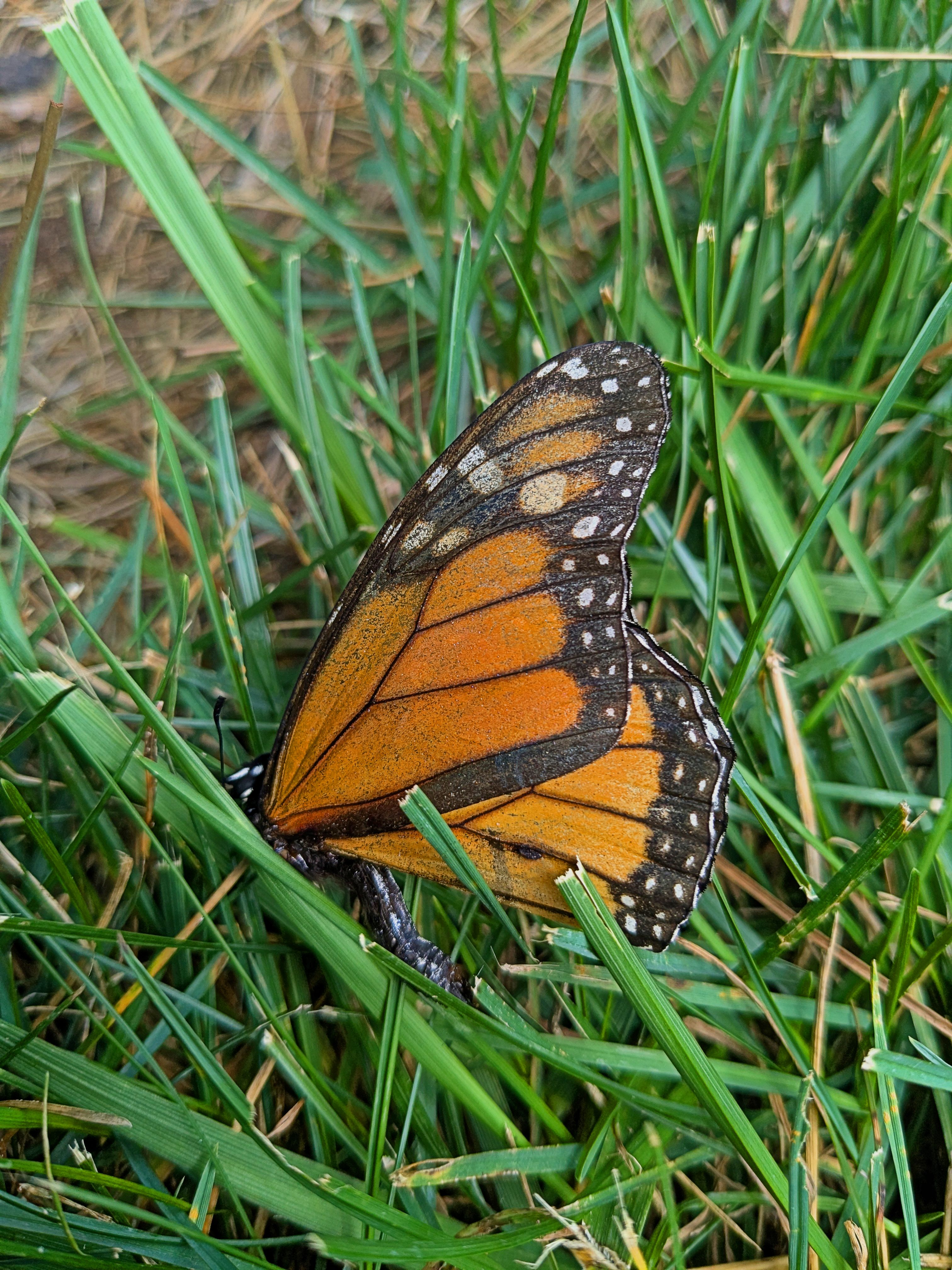
Rounding on another garden, I saw a bit of orange in the grass.  Still and lifeless, a monarch butterfly lay as if it had fluttered softly down and passed on. From the wear on its wings, my guess is that it was the monarch that waited.  A few brilliant days with good company, and its brief two-to-five-week lifespan ended.

Threatened by habitat loss, pesticide use, and climate change, the population of eastern monarchs has declined by more than 80 percent, according to the World Wildlife Federation. The monarch butterfly was classified as endangered by the International Union for Conservation of Nature (IUCN) in 2022. The US Fish & Wildlife Service proposed the monarch butterfly for protection under the Endangered Species Act in December 2024.

Unlike so many ecological crises, there are positive steps individuals can take to help save the monarchs. With even a small space you can plant a few milkweeds or create a Monarch Waystation.  Many of the milkweed and nectar plants that support the monarch life cycle are inexpensive, easy to grow, resilient and drought-resistant once established.

Among other resources, Monarch Watch is a great information and citizen science website established at the University of Kansas in 1992. As of August, 2025, there are 52,932 registered Monarch Waystations across the US. Check out the sites in your state.  While the migration of monarch butterflies used to darken the sky as they passed by, today the existence of the butterfly is in question.  Maybe, with enough help, they will survive.

The newly arrived monarch has taken up residence. It flits and floats, maybe it hopes. I know I do.

* * *

Epilogue:  The next day, another monarch arrived.  In the days that followed, there were as many as four at a time in different gardens. And more are rising from the garden itself, the last generation of the season, which will live six to nine months if they survive their autumn migration of almost 3,000 miles to central Mexico.  Godspeed.


Read Full Post »

Outside

Winter hangs on still green leaves. The autumn lingered this year, and the winter, though timely, blew in on the unsuspecting.

Fluffed flakes swirl from snow bands pushing through overhead.  Autumn has fled.

Winter holds the deep past and the future. Those plants holding leaves are slowly freezing.

It is me that was unsuspecting.

Read Full Post »

The Bee and Me

Spreading mulch in my garden, I felt a sharp sting on my wrist.

Guessing correctly, a small bee tumbled out of my sleeve when I shook my arm.

As my skin reddened, the bee crawled on the ground and twisted on its wing near wet grass. I carefully relocated it to a dry wood chip.  The movement of the bee slowed as it tried to crawl and got nowhere. I watched it move one direction or the other, not straying from the flat chip.

The bee’s only defense took its life. A terrible cost for a moment of fear, even if instinctual.

For humans, most of the time, a mistake made in fear does not usually spell death.

I forgot the pain, but not the bee. I checked on it a few minutes later and it lay still.  Ten minutes later though, it was gone.

It was apparently not a honeybee, the only kind that die after stinging, a fortunate turn after an unfortunate meeting.

Read Full Post »

Killing Frost

It had to happen.

On this morning, the flowers are more brilliant than before.  Brittle frosted petals, leaves, buds. Deepened color in the autumn garden, a medieval sketch of high linear detail, a confection of final color — red, blue, yellow, green, orange. No feature missed. Paused in perfection, flowers held taut in icy fingers.

With the day, the frost relents, the flowers sag to brown mush. A slow exhalation of the garden into the coming season.  Until next year.

Read Full Post »

About 4’ in height, the garden spinner has three wheels of descending size.  Polyester ribbons affixed to each wheel were once brightly colored.  The flag at the base of the spinner, a stitched red ladybug atop a green leaf, points to the direction of the wind.

For the last 20 years, the spinner has held court in the corner of the summer vegetable garden using the breeze, or the winds blustering through, to proclaim its presence. A gentle breeze moves the largest of the wheels first.  A thunderstorm madly propels all three. 

The spinner delighted young children playing in their sandbox or tending the garden. It gaily provided ornamentation at their high school Open House celebrations.  And it stands now, bereft of color, but still fit, in its garden corner.

The spinner has welcomed and harvested the winds of two decades.  It awakens in the Spring, grows quiet as Summer goes to ground in Autumn, and dreams away the Winter in the garage.

At first glance, it is now a tired old spinner whose day has passed.  Is it an artifact too long held for its memory?  While it enjoyed its sunny days, the bluster that overtook this place blew away its color and its more nimble nature.  Visiting this summer, my oldest remarked on its longevity and rightful place in the garden.  Just now, a puff of air moved its wobbly wheels, as it easily pivoted to reveal the direction of the unseen quality that powers it.

The spinner remains.  As stalwart as the day I assembled its plastic and polyester pieces, it fulfills its purpose to translate what is unseen to the visible world.  Not as pretty, but still a structural, kinetic marvel that defies a date with the landfill.

Things change, and sometimes, things remain.

Read Full Post »

A half sunflower seed shell appears as a carved-out canoe.

A platform of fallen bark shards accompanied by curling and broken twigs as sturdy as old fallen logs.

The soil, so solid from above, is strewn with composite pieces, glittering jewels, colored, clear, dark, and stacked deep.

Stray autumn milkweed fluff tucks in under the creamy yellow petal of a spring crocus.

The lilliputian delights of the soil become visible when a photograph is repurposed as a computer background.

Read Full Post »

The shadows of bush branches outside the window fall on the sunlit wall by my table. 

The wind waves and they dance on the wall and along the tabletop.

Life is in those shadows.  Seasons pass, decades, and the shadows send a signal of what is present somewhere, but not within my reach.

Their impression, more fluid than their being, is energy just passing through of the solid object upon which we are more inclined to focus.

Shadows can traverse time, forward and backward, infinite. While the object that opens that door is even now withering to autumn.

Read Full Post »

On Gardening

When you pull weeds, it is a lot easier to see.

Read Full Post »

Up the gentle green hill, mid-morning sun dapples through the leafy ring around this landscape. Pick up speed running down again, laughing, arms akimbo, making fluttering shadows in the sun.

What’s it all for?

Once many of us ran our own green slopes when young.  Half a century later, probably few of those young’uns do.  For me, time has collapsed, my future passed, and the timeless summer day comes again. If only for the exhilarating run past sun, shade, and flower on a peerless blue sky day.

Read Full Post »

There are many type of gardens, most improve with age.  And sometimes age says more about the gardener than the garden.

For as long as I recall, my mother kept a fair-sized garden at the house where I grew up.  Only the second place she ever lived, her garden welcomed many varieties and the occasional native plant, long before native plants were popular in residential gardens.

It was not until my mother was into her 70’s that I learned she did not come to gardening on her own.  It was the chain-smoking, bottle-blonde older neighbor with an affinity for Yorkie dogs that introduced her to the hobby. The neighborhood was new then, mostly rancher homes with no landscaping save  for the barren hardscape of a construction zone.

Mother of two when she moved in, eventually two more children came along, and the garden began to take shape.  Phlox, lilies, ornamental shrubbery, scrub oak, columbine, and a host of perennials came and stayed for the duration. A few larger trees arrived over the years, an Austrian pine, Linden, Quaking aspen, Hawthorne, and Mountain Ash, several of which remain today.

My mother was reliably found in the garden, enriching the soil year after year with a cup or two of peat moss in each planting hole, dipped out of a colorfully painted tin cup that was old even when I was young.

The gardening styles of my mother and I are wholly different.  While my mother established and tended the mainstays of her garden for decades, I cultivate changeability, welcoming volunteers, being romanced by new introductions, stalking my garden with a trowel in one hand and unexpected entrant in the other, looking for the right spot–or sometimes any spot. Her garden was steady, mine forever shape-shifting.

My mother retired some time ago, her garden figuring prominently in each day after that.  She volunteered for years at the local botanical garden, and there is a bench there that bears her name. When I visited home, we walked and talked in the garden, discussing plants and their habits.  As any gardener knows, one of the secrets of a garden is its timelessness.  There is no before, or after, there is simply the face of the garden as it is now.

I visited again last August.  In her 90th year, my mother does not have a great deal of short term memory.  There had been talk of a move to assisted-living, as aging in place with assistance simply wasn’t enough anymore.

After I arrived, we chatted inside the house. I had the discomfiting feeling that my mother could not altogether place me. While I was used to reintroducing topics or people, this was something different.

As we spoke, I glanced out the picture window that takes in a terraced garden in the back of the house.  The garden, long home to a community of robust plantings, was three-quarters covered by an invasive grass, beautiful in the breeze, but entirely hiding the differentiated species that may yet be struggling there. Startled, I asked her about the grass.  She looked out unperturbed, saying only that it grew well there.

Though lovely, the grass is homogeneous, smothering wherever it grows, it has nothing to say and little to show.  A metaphor of the mind, the grass had overtaken the decades of detail of the life that tended it. The gardener is no longer in residence.

A few weeks later, my mother moved into a beautiful assisted living facility.  There are kind people, good meals, and interesting activities.  She adjusted well, with help, over time.  There is a sunny courtyard in which to walk and the garden that I thought she would miss does not come up in our telephone conversations.

COVID-19 is stalking the residents of assisted living and nursing facilities throughout this country.  Family visits curtailed, packages quarantined, employees tested for symptoms on each arrival. But like seeds of invasive grasses, the progenitors of COVID-19 are rarely seen, showing only after the virus has taken hold in a fragile human ecosystem. Like everyone around the world, we can only wait.

On my next visit, I will bring starts of some of the plants in her garden with me, and her garden will live on, far from its original setting. That is the way with gardens, even when the gardener goes home.

Read Full Post »

Older Posts »